
You sit down with your yarn beside you, but you are still feeling unmotivated. Maybe the pattern is already saved. Maybe the hook is right there, waiting quietly on the table. For a moment, you think, “I could start now.”
But you don’t.
You keep scrolling. One thought leads to another, and before you know it, you are waiting for a small spark to appear before you begin.
The confusing part is that you do want to crochet. You want the quiet, the softness, and the feeling of making something with your hands. You want that cozy little pause where the world feels less loud for a while.
But your body feels heavy, your mind feels full, and even something calming starts to feel like one more thing you have to do.
If you have been feeling unmotivated, it does not mean you are lazy. Something deeper may be happening underneath: tiredness, overwhelm, fear of making mistakes, comparison, or the feeling that you have lost the reason you wanted to begin.
Feeling Unmotivated Doesn’t Mean You’re Lazy
When you are feeling unmotivated, it is easy to assume something is wrong with you.
You may look at the yarn you bought, the crochet project you saved, or the pattern you wanted to try, and still feel unable to begin. From the outside, this can look like laziness, but that is not always what is happening.
Sometimes motivation disappears because your mind has been carrying too much for too long. You may still want to crochet, create, rest, or do something meaningful with your hands, but wanting something and having the energy to start are not the same thing.
That difference matters.
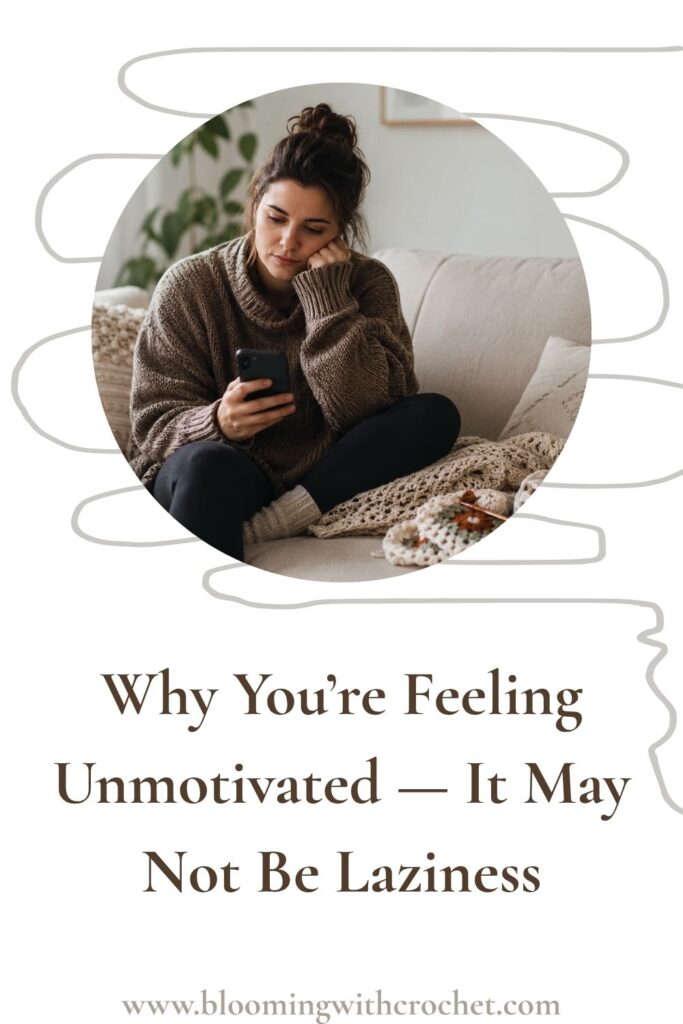
You can truly want something and still feel too drained to begin it.
When you are mentally tired, even something gentle can feel like another responsibility. Even a soft ball of yarn can start to look like a tiny demand sitting on the table.
That is why lack of motivation should not be treated only as a discipline problem. It can be a signal. It may be telling you that you are tired, overwhelmed, afraid of doing something wrong, stuck in comparison, or disconnected from the reason you wanted to begin.
You are not lazy because you cannot force yourself into action.
You may simply need to understand what your lack of motivation is trying to say.
Why You May Be Avoiding Things You Actually Want to Do
One confusing part of feeling unmotivated is that you may avoid things you actually care about.
You may want to crochet, and to make something cozy, calming, and beautiful. You may imagine how nice it would feel to sit down with your yarn, follow an easy crochet pattern, and let your hands move slowly.
But when the moment comes, you scroll on your phone instead.
When you are feeling unmotivated, even something you genuinely enjoy can start to feel harder than it should.
You clean something unnecessary.
And think about starting tomorrow.
You tell yourself you will do it when you feel more ready.
And then tomorrow becomes another tomorrow.
This does not always mean you do not care enough.
Sometimes it means the thing you want has become linked with pressure.
Perhaps you feel like you need to finish the project or make it look good. You may compare your work to someone online who seems faster, neater, or more creative. Or maybe you saved so many ideas that even choosing one now feels tiring.
Crochet can be a relaxing hobby, but if your mind turns it into another test, it can stop feeling relaxing. Instead of feeling like creative comfort, it starts to feel like one more thing you are failing to do.
That is when avoidance begins.
You are not only avoiding the activity. You may be avoiding the uncomfortable feeling around it.
For a beginner, this can be especially strong. Crochet for beginners should feel simple and encouraging, but too many patterns, tutorials, perfect photos, and “shoulds” can quickly make it feel overwhelming.
You may start thinking you need the right yarn, the right pattern, the right mood, and the right amount of time.
Then the small peaceful thing becomes too big to touch.
The Most Common Reasons You Feel Unmotivated
Feeling unmotivated does not have only one reason. This matters because the solution depends on the cause.
If you are tired, you do not need more pressure.
And if you are afraid, you do not need a louder motivational speech.
If you are overwhelmed, you do not need ten more ideas.
You need to understand what is actually happening underneath the lack of motivation.
Emotional tiredness may be one reason. This is the kind of tiredness that does not always go away after one night of sleep. It can come from being responsible for too much, thinking too much, worrying too much, or constantly trying to keep everything together.
When you are emotionally tired, even a small creative activity can feel like it asks for energy you do not have.
Overwhelm may be another reason. You may have too many ideas and not enough calm space to choose one. You may want to make a blanket, a scarf, a bag, a square, a gift, or something for your home, but instead of feeling inspired, your brain feels noisy.
Too many options can make starting harder, not easier, because every choice asks for energy.
And when your energy is already low, even a nice choice can feel like too much.
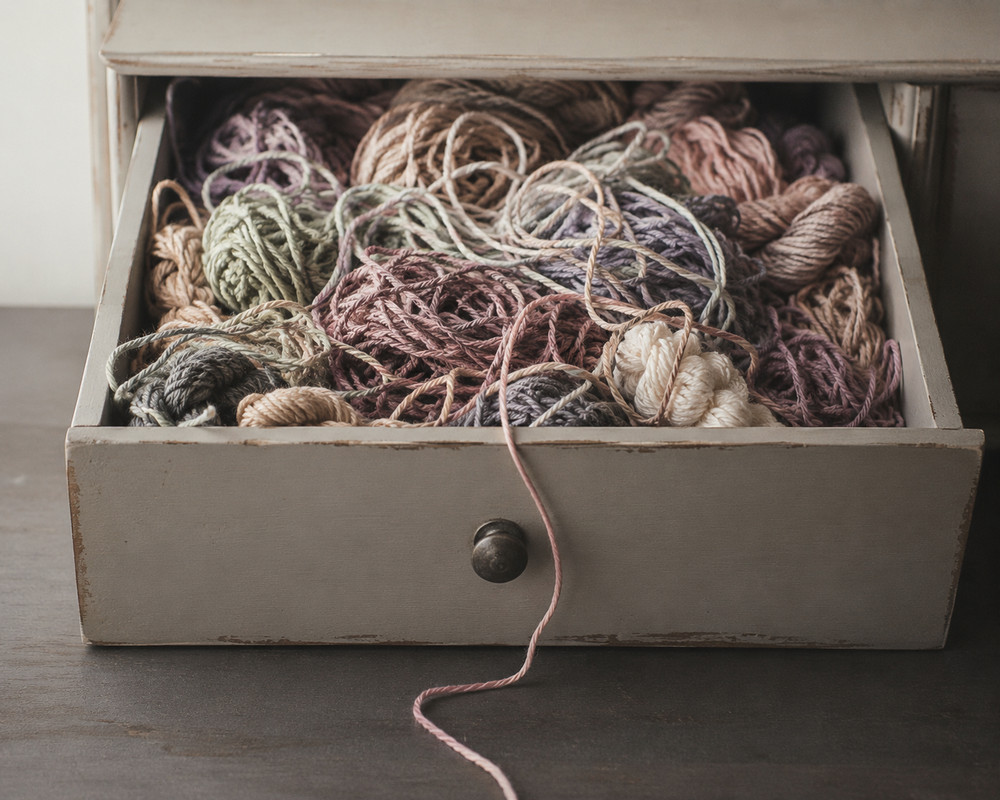
Fear of mistakes can also make motivation disappear, especially with creative hobbies. You may worry that your stitches will look uneven, that you will misunderstand the pattern, that you will waste yarn, or that you will start and not finish again.
When your brain expects disappointment, it may try to protect you by making you avoid the project completely.
Comparison is another common reason.
You may see other people finishing beautiful crochet projects, sharing neat rows, soft colors, cozy photos, and perfect-looking results. Instead of feeling inspired, you may feel behind. You may think, “Why can they do it and I can’t?”
That thought can quietly drain the joy from your own process.
Waiting for the “right moment” can also keep you stuck. You may tell yourself you will begin when the house is quiet, when you have more time, when you feel calmer, when you find the perfect pattern, or when your energy comes back.
But the right moment may not arrive in a perfect form.
Sometimes the gentlest beginning happens in an imperfect moment, with only ten minutes, a half-finished cup of tea, and no big plan.
A quiet feeling of “what’s the point?” can also be the reason. This can happen when you are disconnected from meaning. Maybe you started thinking that crochet only matters if you finish something useful, beautiful, or impressive.
But calming crochet does not have to prove anything.
Mindful crochet can matter because it gives your mind a place to rest for a few minutes.
When Starting Feels Hard, Make It Smaller
When starting feels hard, the answer is not always to push harder.
For many women who feel overwhelmed, pushing harder creates more resistance. It turns a gentle activity into another demand. A softer and more practical approach is to make the beginning so small that it does not feel threatening.
If you are feeling unmotivated, the goal is not to force yourself into a big project, but to make the first step feel manageable.
This may mean telling yourself that one row is enough for today.

Not one hour.
And not one finished square.
Not visible progress that someone else would admire.
Just one row.
You might begin by choosing only the yarn and hook, without starting the pattern yet. Another option is to sit down for ten minutes with no pressure to continue. Even practicing one stitch slowly is enough, whether or not the result is perfect.
This matters because a small beginning lowers the emotional weight of the task.
When your mind is tired, “finish this project” feels heavy.
“Do one row” feels possible.
And possible matters.
A tiny start is not silly. It is often the only kind of start that feels safe enough when you are already stretched thin.
The goal is not to trick yourself into productivity. The goal is to create a gentle doorway back into something that used to feel good.
For crochet, this can be very practical. Instead of choosing a big project when you are already drained, choose an easy crochet pattern or a tiny repeated section. Keep the yarn somewhere visible and simple.
Do not make the setup complicated.
If you have to search for everything, choose colors, find the pattern, watch three tutorials, and clear a perfect space, you may lose energy before you even begin.
A gentle routine can help, but it should not feel strict. For example, you might create a small crochet pause in the evening, after tea, after work, or before scrolling on your phone.
Not as a rule.
Not as another thing to fail at.
Just as a soft invitation: “I can do a few stitches if I want to come back to myself.”
Crochet Can Be a Pause, Not Another Project
Crochet does not have to be only about finishing something.
It can be a pause.
It can be a way to give your hands something calm to do while your mind slowly settles. Crochet for anxiety, crochet for overwhelm, and crochet for stress relief can fit here naturally, not as a cure or a promise, but as gentle support.
When life feels too loud, crochet gives you one small thing you can gently control. You can choose the color, choose the stitch, make one row, and see something small begin to form under your hands. Research on creativity* (Jean-Berluche, 2024) suggests that creative activities can support a sense of agency — that quiet inner feeling of “I can still do something.” For someone who feels overwhelmed, that small feeling of control can matter.

When you repeat a stitch, count slowly, feel the yarn slide through your fingers, and watch one small row grow, your attention has somewhere simple to land.
You are not solving your whole life.
And you are not forcing yourself to be productive.
You are just giving your mind one soft, steady thing to follow.
This is why mindful crochet can feel different from another task on your list. The value is not only in the finished scarf, square, blanket, or bag. It can also be found in the ten quiet minutes when your thoughts are no longer pulling you in every direction.
The value can be in touching something soft, making one small choice, and remembering that you are allowed to move slowly.
Crochet also gives your mind a gentle way to practice flexibility. When you try a new stitch, fix a small mistake, change a color, or adjust a pattern, you are not failing — you are learning how to keep going when things are not perfect. Research on creativity* (Jean-Berluche, 2024) connects creative activity with cognitive flexibility, problem-solving, and seeing situations from more than one angle. In simple words, when you make something with your hands, your mind gets a chance to stop being stuck in only one way of thinking.
Crochet for mental health needs careful wording. It is not a replacement for professional help when someone needs support. But as a calming creative hobby, it can become part of a more peaceful daily rhythm.
It can be a small ritual that says, “I do not have to disappear into my phone every time I feel stressed. I can give my hands something gentle to hold.”
If starting a bigger project feels overwhelming, try this beginner-friendly crochet square pattern and focus on making just one small square at your own pace.
Cozy crochet and slow living fit naturally here because they are not about doing more. They are about creating a little more softness in an ordinary day.
A few stitches can become a private pause.
A small project can become a place where you do not need to perform.
You do not have to finish to make the moment meaningful.
What to Do When Motivation Feels Far Away
When motivation feels far away, try not to treat yourself like a problem that needs to be fixed.
Start by asking what the lack of motivation may be trying to tell you.
Are you tired?
Do you feel overwhelmed?
Is the fear of making a mistake holding you back?
Have you been comparing yourself to others?
Maybe you are waiting for the perfect moment.
Or perhaps you feel that your small effort will not matter.
The answer matters because each reason needs a different kind of care.
Feeling unmotivated can be a sign that you need less pressure, more rest, or a simpler way to begin.
If you are tired, rest may be the honest first step.
When everything feels overwhelming, simplify the choice.
Fear may be a sign that the task needs to feel smaller and safer.
And if comparison is stealing your joy, step away from the noise and return to your own hands, your own yarn, and your own pace.
You do not need a huge wave of motivation to begin again.
You do not need to feel inspired, organized, confident, and ready.
Sometimes you only need one small action that does not scare your nervous system.
One row.
One stitch.
One color choice.
One quiet moment with your yarn.
Feeling unmotivated does not mean you are lazy. It may mean you have been carrying too much, expecting too much, or turning something gentle into something heavy.
Crochet does not have to become another project you pressure yourself to complete.
It can be a small way back to calm, focus, and creative comfort.
For today, enough can be very small.
One row can be enough.
Ten minutes can be enough.
Returning without explaining yourself can be enough.
References
Jean-Berluche, D. (2024). Creative expression and mental health. Journal of Creativity, 34(2), Article 100083. DOI: 10.1016/j.yjoc.2024.100083 https://www.sciencedirect.com/science/article/pii/S2713374524000098